Welcome to Shandong Jiyang Machinery Factory(Skyscraper Machinery)!


Electric Lift: What are the operating procedures and maintenance of a small electric lift?
Publish Time:
Nov 29,2021
Electric hoist: I. Operation procedure for small electric hoist: 1. Before operation, check for air obstacles and high-voltage lines. According to current regulations and standards, the platform must maintain a safe distance from energized high-voltage lines at all times and must not cross them. Work must be carried out on a firm and level surface, and the load and distribution on the platform must comply with the manufacturer's specifications. 2. During operation, personnel on the platform should always have a stable footing.
Electric Lift I. Operating Procedures for Small Electric Lifts:

1. Before operation, check for air obstructions and high-voltage lines. Maintain a safe distance from energized high-voltage lines at all times, in accordance with current regulations and standards; do not cross them. Work must be carried out on a firm, level surface. The load on the platform and its distribution must comply with the manufacturer's specifications.
2. During operation, personnel on the platform should always have a stable footing.
3. If any malfunction or misoperation occurs during operation, it should be rectified immediately before further use.
4. Do not alter, modify, or discard safety devices.
5. When the platform is rising, descending, or moving, be careful to prevent entanglement of wire ropes, wires, hoses, etc.
II. 1. Usage Electric Lift requires no fewer than three operators.
2. Power on the main unit, install the platform railing, and carefully check for any hidden dangers that may affect on-site operations.
3. Open the outriggers and rotate the support rotary rod to secure it to the ground. Adjust the outriggers horizontally one by one, but it is not suitable to lift all four wheels off the ground.
4. Push the lifting cylinder handle to slowly raise the gate valve cylinder. Release the push rod after the push rod is vertically in place.
5. Observe the level gauge and fine-tune the outrigger level. Note: The iron position may be damaged or manually offset. When adjusting the oil level, observe the verticality of the telescopic cylinder. If any problems are found, check the oil level. Do not lift the electric lift until the problem is resolved.
6. The telescopic cylinder base has two M12 screw holes on each side for fixing the telescopic cylinder. Remember: The fixing screws must be fastened before lifting the platform. If the electric lift needs to be tilted and moved after use, the fixing screws must be loosened.
7. Loosen the anti-rotation ladder clamping screw after the cylinder is vertical, and install the anti-rotation ladder clamping screw before unloading.
8. Set the switch to the manual position and check the manual button. Set the switch to the remote control position and check the remote control.
9. The operator boards the electric lift, checks whether the railing screw connections are firm, and fastens the seat belt.
10. Start the remote control button or operate by ground personnel.
III. Maintenance of Small Electric Lifts:
1. Drain and discard the hydraulic oil, tighten the joints, remove the oil filter, clean it, clean it with compressed air, then return it to the oil tank, and connect the pipeline.
2. Remove and disassemble the lifting descent valve, clean the plunger with compressed air, then install and reinstall. Check all hydraulic lines and joints. The pipes must not be damaged, and the joints must not be loose. All joints must be tightened.
3. Oil quality and oil level of hydraulic oil. The electric lift should be always lifted. At this position, the hydraulic ground should be 40~50mm higher than the bottom of the tank. If the hydraulic oil is found to be dark, viscous, or contains foreign matters such as gravel, it should be replaced in time.
4. Add an appropriate amount of lubricating oil to various parts to extend the service life of the hoisting hook bearing. Check whether the rollers, intermediate shafts, bearings, cylinder pins, bearings, boom hinge shafts, and bearings of the hydraulic lift are worn.
5. Pressure must be released from any part of the hydraulic system to prevent pressure oil from spraying out and the elevator worktable from sliding suddenly.
6. The relief valve must not be adjusted at will. Each component in the hydraulic lifting system works under the specified pressure. Any adjustment of the safety valve may cause abnormal operation of the hydraulic system.
Shandong Jiyang Machinery Factory Co., Ltd. mainly produces freight elevators, loading ramps, lifting tables, lifts, lifting freight elevators, lifting platforms, electric lifts, hydraulic lifting tables, hydraulic lifts, scissor lifts, guide rail lifts, hydraulic lifting platforms, fixed lifting platforms, guide rail lifting platforms, scissor lifting platforms, etc. The company has strong technical force, sophisticated production equipment, advanced and reasonable technology, and complete testing means. Our company is a drafting unit of the standard for scissor-type hydraulic lifting platforms. Products are widely used in construction engineering, industrial installation, equipment maintenance, factory maintenance, property management, three-dimensional warehouses, aviation, airports, ports, stations and many other industries and places.
BLOGS
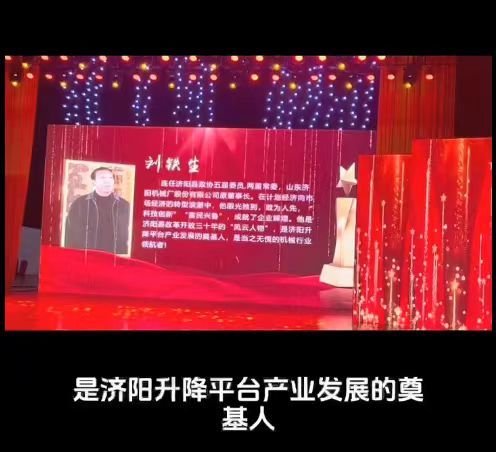
Liu Tiesheng was re-elected as a member of the Jiyang County CPPCC for five consecutive terms and served two terms as a standing committee member. He is the former chairman of Shandong Jiyang Machinery Factory Co., Ltd. During the transition from a planned economy to a market economy, he demonstrated exceptional foresight and courage, leading the way in technological innovation and contributing to the prosperity of Shandong Province and the nation. His achievements made the company a shining success. He is considered a prominent figure in Jiyang County's 30 years of reform and opening up, a pioneer in the development of the Jiyang lifting platform industry, and a well-deserved leader in the machinery industry!

Introduction to the civil engineering advantages of rail-guided lifting platforms
Guide rail lifting platform is a kind of non-scissor hydraulic lifting mechanical equipment, used for cargo transmission between floors of two or three-story industrial plants, restaurants, and hotels. It can have a low height of 150-300mm, especially suitable for workplaces where pits cannot be excavated, and does not require upper suspension points. It comes in various forms (single-column, double-column, four-column). The equipment operates smoothly. The guide rails of the guide rail lifting platform are generally made of channel steel, I-beams, and square tubes welded together. It is simple, reliable, and economical for cargo transmission. Hydraulic lifting platforms are multifunctional lifting and handling mechanical equipment with lifting heights ranging from 1m to 30m. They can also be customized according to different user needs.

What is the purpose of a guide rail lift platform?
Rail-guided lifting platforms are widely used and are a popular product on the market due to their various advantages. However, there are many points of knowledge that need to be understood when using them, as many users are not aware of them. Next, let me introduce the uses of rail-guided lifting platforms. Those interested can read on.
How to maintain a guide rail lift platform?
The advantages of rail-type lifting platforms lie in the hydraulic system's anti-falling and overload safety protection devices. The railings on each floor and the lifting platform are made of stainless steel. In addition, they feature high load-bearing capacity, high stability, and a long service life. Below are some maintenance methods for rail-type lifting platforms.

What are the advantages of a guide rail lift platform?
The industry of guide rail lifting platforms has a bright future. They offer numerous benefits to businesses, making them highly popular among customers. To help people become more familiar with them, let's discuss the advantages of guide rail lifting platforms. Hopefully, this will be helpful to many.
Dry goods sharing: Understand the functions of a guide rail lift platform in one minute
A rail-guided lifting platform is a hydraulic lifting platform consisting of a hydraulic lifting section, guide rails, and a loading platform. What is the purpose of a rail-guided lifting platform?
Shandong Jiyang Machinery Factory
Tel: 86-531-84211935 86-531-84222430
Fax: 86-531-84211081
Mobile: 86-185-6002-7566
Email: sdjyjxc@126.com
Address: No. 1, Mechanical Industry Park, Jiyang District, Jinan City, Shandong Province (West side of G220 line, Huihe Street)


Mobile Website