Welcome to Shandong Jiyang Machinery Factory(Skyscraper Machinery)!


Hydraulic Lift Platforms: What are the classifications of hydraulic lift platforms?
Publish Time:
Oct 31,2021
What are the classifications of hydraulic lifts? Based on the different structures of hydraulic lifts, there are: scissor lifts, lift lifts (the term 'lift' seems repeated here, possibly a typo), telescopic lifts, articulated arm lifts, and folding lifts. Based on different movement methods, there are: fixed lifts, towed lifts, self-propelled lifts, vehicle lifts, and driver-operated lifts.
What are the classifications of hydraulic lift platforms?
Based on the different structures of hydraulic lift platforms, there are: scissor lifts, hoist lifts, telescopic lifts, arm lifts, folding lift platforms, etc.
Based on Hydraulic Lift Platform the different methods of movement, there are: fixed lifts, traction lifts, autonomous lifts, vehicle lifts, and driver-operated lifts, etc.

Fixed Lift
The fixed lift, known for its stability and wide range of applications, is mainly used for transporting goods between different heights on a production line. Applications include material handling during online/offline component assembly, adjusting work piece height, supplying high-feed lines; lifting components during the assembly of large equipment, lifting and lowering materials and bedplates of machine tools; and quick unloading of goods with forklifts at warehouse unloading locations. According to usage requirements, the lift can be configured with any combination of safety devices such as protective devices for fixed lift platforms. Options include electrical control methods, work platform styles, and power types. A wide variety of configurations allows for maximum functionality and optimal performance of the lift platform.
Optional configurations for fixed lifts include: manual hydraulic power, movable panels for easy access to surrounding facilities, rolling or motorized rollers, safety pinch guards, bellows safety shields, manual or motorized rotating work tables, hydraulic tilting work tables, safety supports to prevent lift drops, stainless steel safety nets, electric or hydraulic lift drive systems, and luggage counter tops.
Vehicle-mounted Lift
Vehicle-mounted lifts enhance mobility by fixing the lift to a battery-powered transport vehicle or truck, using the vehicle's engine power to raise the platform. This is suitable for high-altitude work both inside and outside factories. It can also be widely used for temporary high-altitude lighting, advertising, and other high-altitude operations in hotels, buildings, airports, stations, stadiums, workshops, and warehouses.
Hydraulic lifts are widely used in automotive, container, mold manufacturing, wood processing, chemical filling and other industrial enterprises and production lines. While meeting various height requirements, they can also utilize a variety of table designs, such as those with balls, rollers, turntables, steering, tilting, and telescopic functions.
Curved eight-shaped platform.
Curved arm-type high-altitude work lifts can perform stretching operations, overcoming certain obstacles or raising at multiple points to perform multi-point operations. The platform has a large load capacity, allowing two or more people to work simultaneously and load specific equipment. The lift is highly mobile and easy to move to different locations. Its sleek appearance is suitable for both indoor and outdoor work and storage. It is applicable to various operations at stations, docks, shopping malls, stadiums, residential communities, factories, and mine workshops.
Throw-type Hydraulic Lift Platform
Throw-type hydraulic lifts use multi-stage hydraulic cylinders for vertical ascent. High-strength materials and excellent mechanical properties of the hydraulic cylinders and a tower-shaped trapezoidal support structure ensure greater stability. Excellent stability is maintained even at 30 meters. Applications include installation and maintenance of power lines, lighting fixtures, overhead pipes, high-altitude cleaning, and other high-altitude single-person operations at factories, hotels, buildings, shopping malls, stations, airports, and stadiums.
Shandong Jiyang Machinery Factory Co., Ltd. mainly produces freight elevators, loading ramps, lift tables, lifts, lift elevators, lift platforms, electric lifts, hydraulic lift tables, hydraulic lifts, scissor lifts, guide rail lifts, hydraulic lift platforms, fixed lift platforms, guide rail lift platforms, and scissor lift platforms, etc. The company boasts strong technical capabilities, excellent production equipment, advanced and reasonable processes, and complete testing means. Our company participated in drafting the standard for scissor-type hydraulic lift platforms. Our products are widely used in construction engineering, industrial installation, equipment maintenance, factory maintenance, property management, three-dimensional warehousing, aviation, airports, ports, and stations, across many industries and locations.
BLOGS
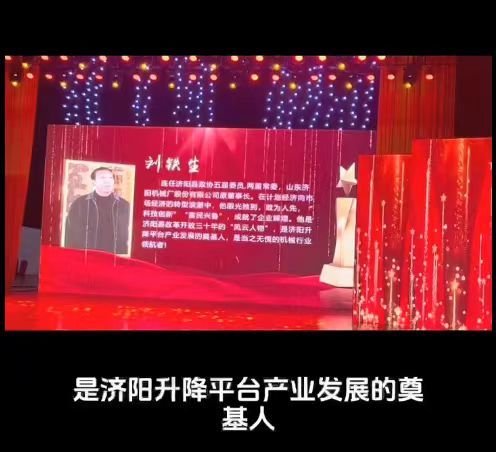
Liu Tiesheng was re-elected as a member of the Jiyang County CPPCC for five consecutive terms and served two terms as a standing committee member. He is the former chairman of Shandong Jiyang Machinery Factory Co., Ltd. During the transition from a planned economy to a market economy, he demonstrated exceptional foresight and courage, leading the way in technological innovation and contributing to the prosperity of Shandong Province and the nation. His achievements made the company a shining success. He is considered a prominent figure in Jiyang County's 30 years of reform and opening up, a pioneer in the development of the Jiyang lifting platform industry, and a well-deserved leader in the machinery industry!

Introduction to the civil engineering advantages of rail-guided lifting platforms
Guide rail lifting platform is a kind of non-scissor hydraulic lifting mechanical equipment, used for cargo transmission between floors of two or three-story industrial plants, restaurants, and hotels. It can have a low height of 150-300mm, especially suitable for workplaces where pits cannot be excavated, and does not require upper suspension points. It comes in various forms (single-column, double-column, four-column). The equipment operates smoothly. The guide rails of the guide rail lifting platform are generally made of channel steel, I-beams, and square tubes welded together. It is simple, reliable, and economical for cargo transmission. Hydraulic lifting platforms are multifunctional lifting and handling mechanical equipment with lifting heights ranging from 1m to 30m. They can also be customized according to different user needs.

What is the purpose of a guide rail lift platform?
Rail-guided lifting platforms are widely used and are a popular product on the market due to their various advantages. However, there are many points of knowledge that need to be understood when using them, as many users are not aware of them. Next, let me introduce the uses of rail-guided lifting platforms. Those interested can read on.

How to maintain a guide rail lift platform?
The advantages of rail-type lifting platforms lie in the hydraulic system's anti-falling and overload safety protection devices. The railings on each floor and the lifting platform are made of stainless steel. In addition, they feature high load-bearing capacity, high stability, and a long service life. Below are some maintenance methods for rail-type lifting platforms.
What are the advantages of a guide rail lift platform?
The industry of guide rail lifting platforms has a bright future. They offer numerous benefits to businesses, making them highly popular among customers. To help people become more familiar with them, let's discuss the advantages of guide rail lifting platforms. Hopefully, this will be helpful to many.
Dry goods sharing: Understand the functions of a guide rail lift platform in one minute
A rail-guided lifting platform is a hydraulic lifting platform consisting of a hydraulic lifting section, guide rails, and a loading platform. What is the purpose of a rail-guided lifting platform?
Shandong Jiyang Machinery Factory
Tel: 86-531-84211935 86-531-84222430
Fax: 86-531-84211081
Mobile: 86-185-6002-7566
Email: sdjyjxc@126.com
Address: No. 1, Mechanical Industry Park, Jiyang District, Jinan City, Shandong Province (West side of G220 line, Huihe Street)


Mobile Website